

On this page
- 1How much deposit for a kitchen remodel is reasonable?
- 2What a kitchen remodel deposit pays for
- 3Why paying in stages protects you
- 4A safe kitchen remodel payment schedule
- 5What to check before each payment
- 6Signs your payments are getting ahead of the work
- 7Deposit red flags
- 8Paying a contractor in full: when is it safe?
- 9Extra protection for larger projects
- 10Payment schedules for small and large kitchens
- 11Paying with a loan
- 12How payments are tied to the contract
- 13What if the contractor takes the deposit and disappears?
- 14Keep a simple payment log
- 15How we structure payments
- 16FAQs
- 17Pay as the work gets done
The contractor wants a check before anything happens. You want to know how much is fair, and how much is too much.
Your payment schedule is your strongest protection. It decides how much money is at risk at any moment.
How much deposit for a kitchen remodel is reasonable?
Washington L&I advises a “reasonable down payment,” then paying only as specific phases are finished. It lists large deposits or full payment up front as a red flag. A safe deposit covers early costs, not the whole job.
L&I’s Hire Smart page does not name a set percentage. It does say to “pay your contractor only when specific phases of a project are completed.”
So the right question is not just “how much?” It is “what is this deposit paying for?”
What a kitchen remodel deposit pays for
A deposit usually holds your spot on the schedule. It covers early costs like design or a first material order.
Kitchen jobs often have large early purchases. Cabinets in particular may need to be ordered weeks before demolition.
A fair deposit should match those early costs. If a contractor asks for far more than they will spend before work starts, ask why.
Questions to ask about the deposit:
- What exactly does the deposit cover?
- Is any part refundable if the project is cancelled?
- When will materials be ordered, and can I see the order?
- Who is the payee on the check?
Why paying in stages protects you
Paying in stages keeps your money in step with finished work. If something goes wrong, less of your money is at risk.
Think of it this way. At every stage, the value of the work done should be close to what you have paid.
If you pay far ahead of the work, you carry the risk. If the contractor stops showing up, you may have paid for work that never happens.
L&I also says to “Avoid paying for your project in full until all work is completed and you are satisfied with the work.”
A safe kitchen remodel payment schedule
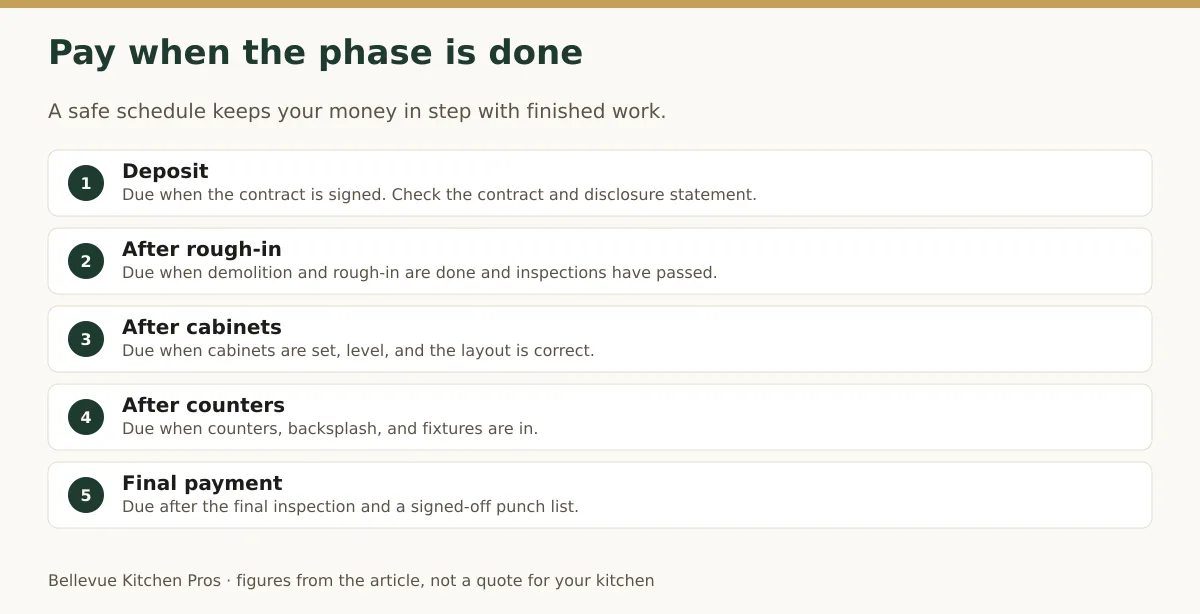
Tie each payment to a phase you can see and check. Hold the final payment until the final inspection passes and the punch list is done.
Here is an example structure. It is not a legal requirement, and your contract may differ.
| Stage | Payment is due when | What you can check |
|---|---|---|
| Deposit | Contract is signed | Signed contract and disclosure statement |
| Payment 2 | Demolition and rough-in are done | Rough-in inspections passed |
| Payment 3 | Cabinets are installed | Cabinets set, level and correct |
| Payment 4 | Counters and finish work are done | Counters, backsplash, fixtures in |
| Final payment | Final inspection and punch list complete | Passed final, punch list signed off |
Each stage has a clear trigger. You never pay for a phase you cannot see.
Holding back part of each payment
Some homeowners and contractors agree to hold back a small share of each payment until the end. This is often called retainage.
It gives both sides a reason to finish the punch list. If you want it, write the amount and release terms into the contract. Do not add it on your own mid-job.
What to check before each payment
Before you pay, walk the work, check the inspection record and collect lien releases for that phase.
A quick checklist for each payment:
- The work for that phase is done, not just started.
- Any required inspection passed. Bellevue requires work to be inspected before it is covered.
- Change orders for that phase are signed and priced.
- Lien releases from major subs and suppliers paid so far.
- The invoice matches the contract schedule.
L&I advises you to “request a completed lien release from all major subcontractors and suppliers.” That protects you from paying twice if the contractor does not pay them.
Signs your payments are getting ahead of the work
If you have paid for more than you can see, slow down. Ask for a walkthrough before the next payment.
Warning signs:
- An invoice arrives for a phase that has not started.
- Materials you paid for have not been ordered or delivered.
- The crew is on site less often after a payment clears.
- Subcontractors mention they have not been paid.
- Requests for “a little extra” outside the written schedule.
Any of these is worth a direct conversation. Ask for order confirmations, delivery dates and lien releases. Put your questions in writing, and keep copies.
Deposit red flags
Large deposits, cash-only demands and pressure to pay today are classic warning signs.
L&I lists these red flags:
- A contractor who will “Only accept cash, require large deposits or the entire cost up-front”
- A special price only if you sign today
- Asking you to get the building permit
- Asking to be paid in their own name instead of the business name
Any one of these is a reason to slow down. Two or more is a reason to walk away.
Paying a contractor in full: when is it safe?
Pay the final balance only when the work is complete. The final inspection should pass, and you should sign off on the punch list.
The punch list is the list of small fixes at the end. Think a scratched panel, a loose hinge or missing caulk.
Holding the final payment until it is done keeps everyone focused on finishing. It is also what L&I recommends.
Ask for these before the final check:
- A copy of the passed final inspection
- Final lien releases
- Appliance and fixture manuals and warranties
- The written workmanship warranty
Extra protection for larger projects
For projects over $6,000, L&I says to consider asking your contractor to post a performance bond.
A performance bond is separate from the contractor’s registration bond. It is tied to your project. It helps cover the cost of finishing if the contractor does not.
Registration bonds are smaller and shared. Washington requires a $30,000 bond for general contractors and $15,000 for specialty contractors under RCW 18.27.040. Many claims can draw on the same bond.
Payment schedules for small and large kitchens
Small jobs need fewer payments. Large jobs need more stages, so no single payment gets far ahead of the work.
A cosmetic refresh might have just a deposit and a final payment. The work is short, and the risk is lower.
A full remodel runs for weeks or months. Five or more stages keep each payment close to finished work.
A rough guide:
| Project | Typical number of payments |
|---|---|
| Small refresh | 2 to 3 |
| Same-layout remodel | 4 to 5 |
| Full or structural remodel | 5 or more |
These are common patterns, not rules. What matters is that each payment matches work you can see.
Paying with a loan
If you borrow for the remodel, match your draws to the payment schedule. A HELOC lets you draw as each phase is due.
Do not borrow the full amount just to pay a large deposit. You pay interest on money that is not yet earning work.
The CFPB notes that HELOCs usually have variable rates. Plan your repayment with that in mind.
How payments are tied to the contract
Your payment schedule belongs in the written contract, with each stage described plainly.
L&I lists “Payment terms, such as paying as work is completed and completion date” as a contract basic. Our kitchen remodel contract checklist covers every item a contract should include.
What if the contractor takes the deposit and disappears?
Stop paying, document everything and contact L&I. You may be able to sue against the bond.
L&I’s problems with a contractor page says you “can file suit against their bond” if you cannot resolve serious problems. Some owners may also qualify for the state Homeowner Recovery Fund. It can pay up to $25,000, depending on available funds.
For step-by-step options, see what to do if a contractor abandoned the job in Washington.
Keep a simple payment log
Track every payment in one place. It makes each check easier and any dispute simpler.
Log these for each payment:
- Date and amount
- The phase it paid for
- Check number or transfer record
- Lien releases received
- Any change orders included
A one-page log can save hours if a question comes up later.
Review the log before each payment. If anything looks off, ask before you pay.
How we structure payments
Bellevue Kitchen Pros plans and builds kitchens from start to finish. Our contracts tie each payment to a finished phase you can see.
You know what each payment covers before you make it. The final payment comes after the final inspection and your punch list sign-off.
Learn more about how we work on our kitchen remodeling in Bellevue page.
FAQs
What percentage should a contractor deposit be?
L&I’s guidance does not name a set percentage. It advises a reasonable down payment, then paying only as specific phases are finished. Large deposits are on its red flag list. Ask what the deposit covers, such as design or a first material order. Keep it close to those early costs.
Is it normal to pay for cabinets up front?
It is common for a contractor to order cabinets early, because lead times can be long. A payment tied to that order can be reasonable. Ask to see the order confirmation and ship date. Make sure the payment is written into the contract schedule, not added later.
Should I ever pay a contractor in cash?
It is safer to pay by check or traceable transfer to the business name. L&I lists a contractor who only accepts cash as a red flag. It also flags requests to pay the owner personally instead of the business. A paper trail protects you if there is a dispute.
When should I make the final payment?
Make the final payment after the final inspection passes and you sign off on the punch list. L&I advises avoiding full payment until all work is complete and you are satisfied. Collect final lien releases, warranties and inspection copies before you hand over the last check.
Is a kitchen remodel deposit refundable?
It depends on your contract. Some deposits are partly refundable if you cancel before materials are ordered. Others are not, because design time or custom orders have already started. Ask before you sign, and get the refund terms in writing. Never assume a deposit comes back.
Pay as the work gets done
How much deposit for a kitchen remodel is fair? Enough to cover early costs, and no more. Then pay by finished phase and collect lien releases. Hold the final check until the job is done.
Book a consultation and we will show you a phase-by-phase payment schedule for your Bellevue kitchen.
Written by
Daniel Brooks
Daniel Brooks has worked in kitchen remodeling since 2020. He leads the planning guides at Bellevue Kitchen Pros and focuses on Bellevue kitchen remodels: how layouts, cabinets and counters fit local homes, what the City of Bellevue requires for permits, and how costs break down from a minor refresh to a full remodel. He writes in plain steps, links every figure to its source, and updates guides when local rules or prices change.
Planning notes are general. Confirm engineering, permits, and price with a licensed Washington contractor.