
On this page
- 1What should you do if a contractor abandoned the job in Washington?
- 2First, is the job really abandoned?
- 38 steps to take if your contractor disappeared
- 4How to sue a contractor’s bond in Washington
- 5The Homeowner Recovery Fund in Washington
- 6Contractor disappeared with the deposit in Washington
- 7Poor workmanship: a different problem
- 8Report the contractor
- 9How to avoid this next time
- 10What to put in your written notice
- 11Keep your kitchen usable in the meantime
- 12When to talk to a lawyer
- 13How we help finish stalled kitchens
- 14FAQs
- 15Act fast, act in order
Your kitchen is torn apart. The crew stopped coming, calls go to voicemail and you have already paid.
It is stressful. But Washington gives homeowners real options, and the order you act in matters.
What should you do if a contractor abandoned the job in Washington?
Stop paying, document everything, send a written notice and check the contractor on L&I. If you cannot resolve it, you can file suit against the contractor’s bond. Some homeowners may also qualify for the state Homeowner Recovery Fund, which can pay up to $25,000.
L&I’s problems with a contractor page says: “If you are unable to resolve serious problems with a contractor, you can file suit against their bond.”
First, is the job really abandoned?
Before you act, confirm the contractor has stopped work without a reason. Some delays have a real cause.
Fair reasons for a pause:
- Waiting on cabinets, a slab or special-order parts
- Waiting on a City inspection
- A change order you have not signed yet
Warning signs of abandonment:
- No contact for days or weeks
- No crew and no clear reason
- Tools and materials removed from the site
- Requests for more money before work resumes
If you are not sure, send a written message asking for a schedule by a set date. Keep a copy.
8 steps to take if your contractor disappeared
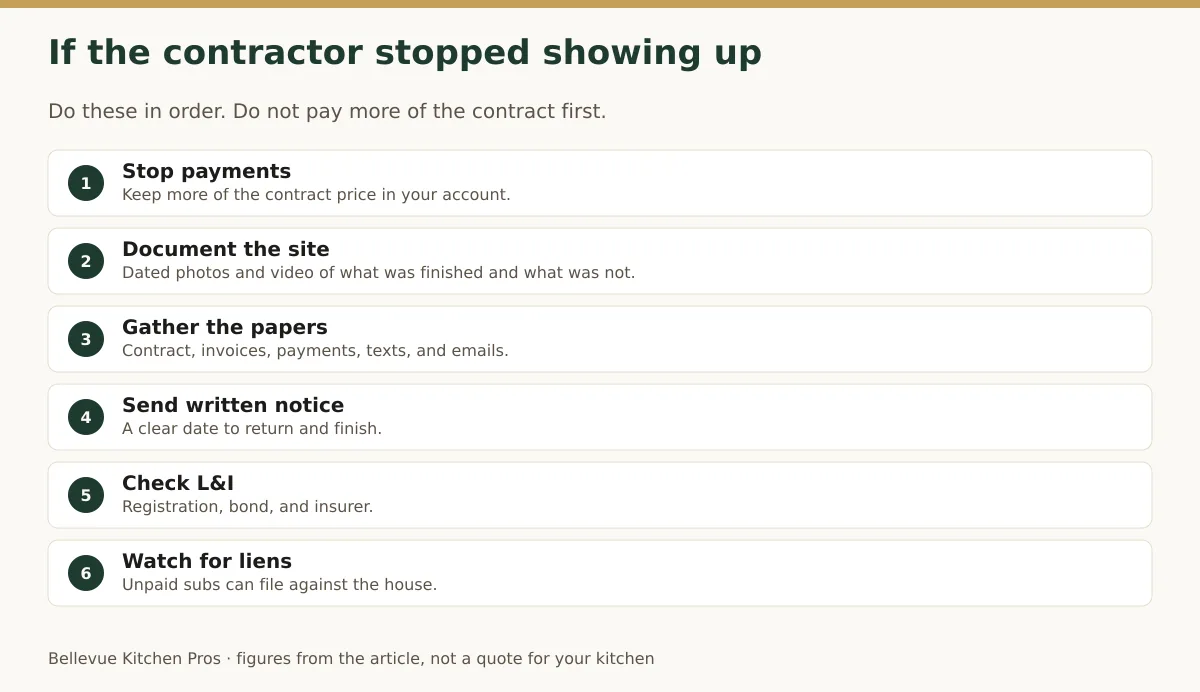
Act in this order. Each step protects your options for the next one.
| Step | What to do | Why it matters |
|---|---|---|
| 1 | Stop all payments | Keeps more money from going out |
| 2 | Document the site | Photos and video prove what was done |
| 3 | Gather records | Contract, invoices, payments, messages |
| 4 | Send a written notice | Gives a clear deadline to return |
| 5 | Check L&I | Confirms registration, bond and insurer |
| 6 | Protect against liens | Unpaid subs may file on your home |
| 7 | Claim against the bond or insurance | Your main source of recovery |
| 8 | Hire a registered contractor to finish | Gets your kitchen back |
Step 1: Stop all payments
Do not send more money until the contractor returns to work or the problem is resolved. If you used a loan with draws, pause those too.
Step 2: Document the site
Take dated photos and video of every area. Show what is finished, what is not and any damage. Do this before anyone else touches the work.
Step 3: Gather your records
Collect your contract, bids, change orders, invoices, receipts, cancelled checks and every message. Put them in one folder.
Step 4: Send a written notice
Send a letter or email that lists the problem, what you expect and a deadline to respond. Keep it calm and factual. Keep proof it was sent.
Step 5: Check the contractor on L&I
Look them up on the free L&I Verify tool. Note the registration status, bond company and insurance details. You will need them for any claim.
Step 6: Protect against liens
If the contractor did not pay subs or suppliers, they may file a lien on your home. Washington allows a lien to be recorded within 90 days after they stop furnishing labor or materials.
L&I says: “If you receive a lien notice, take it seriously. Let your contractor know you have received the notice.” Our guide to construction liens for Washington homeowners explains what to do.
Step 7: Claim against the bond or insurance
If the problem is unfinished or poor work, the contractor’s bond may help. If the problem is damage to your home, contact the insurer. L&I says: “You need to contact your contractor’s insurer directly to make your claim.”
Step 8: Hire a registered contractor to finish
Get the remaining work bid in writing. Show the new contractor your photos and records. They may need to check or redo some work before they can finish it.
How to sue a contractor’s bond in Washington
You can file suit against a registered contractor’s bond. The bond amount is $30,000 for general contractors and $15,000 for specialty contractors.
Those amounts come from RCW 18.27.040. L&I points homeowners to a “Filing a suit against a contractor” guide on its site.
Keep in perspective what the bond covers. It is a limited fund. Several claims can draw on the same bond. If others claim first, less may be left.
Many homeowners talk to a lawyer before filing. A lawyer can explain deadlines and whether your claim fits the bond.
The Homeowner Recovery Fund in Washington
The L&I Homeowner Recovery Fund can pay eligible homeowners up to $25,000. You need a court judgment against a registered contractor, and payment depends on funds.
The Homeowner Recovery Fund page lists the main rules:
| Rule | What L&I says |
|---|---|
| Maximum | “up to $25,000, depending on available funds” |
| Home type | Single-family or up to four units; “Condominiums excluded” |
| Occupancy | You must own and occupy the home |
| Contractor | Must have been registered with L&I |
| Court step | Get a final judgment in superior court |
| Timing | The judgment must be ordered after July 1, 2026 |
| Deadline | “Apply to the fund within 90 days after the court case ends” |
If funds run short, L&I uses a waitlist. Condo owners do not qualify.
Contractor disappeared with the deposit in Washington
If a contractor took a deposit and never started, the same steps apply. Stop payment if you can, document the deal and contact L&I.
Ask your bank or card issuer whether a payment can be stopped or disputed. Act quickly, since time limits apply.
L&I lists large deposits up front as a red flag. That is one reason to keep deposits small and pay by finished phase.
Poor workmanship: a different problem
If the work is finished but poor, send a written list of defects and ask for fixes.
Steps for poor workmanship:
- List each problem with photos.
- Send the list in writing with a deadline.
- Check whether the work passed City inspection.
- Get a second opinion from another registered contractor.
- Consider a bond claim if the contractor refuses to fix it.
In Bellevue, permitted work must be inspected before it is covered. If the contractor covered work without inspection, the City may require it to be opened.
Report the contractor
You can report unregistered or fraudulent contracting to L&I.
L&I’s Report-a-Fraud line is 1-888-811-5974. You can also report online. Reporting helps protect other homeowners.
The Washington Attorney General refers contractor complaints to L&I. It cannot act as your private attorney.
How to avoid this next time
Most abandoned jobs start with a large deposit, a vague contract or an unregistered contractor.
What works:
- Verify registration on L&I before you sign.
- Get a full written contract with scope, price and dates.
- Pay a small deposit, then pay by finished phase.
- Collect lien releases with each payment.
- Consider a performance bond on projects over $6,000, as L&I suggests.
To spot trouble before you sign next time, see our list of contractor red flags.
What to put in your written notice
Your notice should be short, calm and specific. It sets a clear record of what you asked for and when.
Include:
- Your name, address and the contract date
- What work is unfinished or defective
- What you are asking the contractor to do
- A firm date to respond or return to work
- How to reach you
Send it by email and by mail with tracking. Keep copies of both.
Keep your kitchen usable in the meantime
A stalled job can leave you without water, power or a safe space. Fix urgent safety issues first.
Call a registered electrician or plumber for any exposed wiring, open gas lines or leaks. Document the condition before and after.
Set up a temporary kitchen in another room. A microwave, kettle and small fridge go a long way.
When to talk to a lawyer
Talk to a lawyer if a lien is recorded or a large sum is at stake. Do the same before a bond suit or a Recovery Fund claim.
The Recovery Fund requires a superior court judgment. A lawyer can explain what that takes and what deadlines apply. This post is general information, not legal advice.
Stay calm and keep everything in writing. A clear record is your strongest tool in every step that follows.
How we help finish stalled kitchens
Bellevue Kitchen Pros plans and builds kitchens from start to finish. If your project has stalled, we review the work against code. Then we give you a written plan to finish.
You get an itemized bid for the remaining work. We pull any needed permits in our own name and schedule the inspections.
Learn more about our approach to kitchen remodeling in Bellevue.
FAQs
What can I do if my contractor takes the deposit and disappears in Washington?
Stop any further payments and ask your bank about disputing the payment. Document the agreement and every message. Check the contractor on the L&I Verify tool. If they are registered, you may be able to file suit against their bond. You can also report them to L&I’s Report-a-Fraud line.
How much can I recover from a contractor’s bond in Washington?
The bond is $30,000 for general contractors and $15,000 for specialty contractors under RCW 18.27.040. Several claims can draw on one bond, so you may not get the full amount. A lawyer can help you understand how a bond claim works for your situation.
Who qualifies for the Homeowner Recovery Fund?
You must own and occupy a single-family home or a building with four or fewer units. Condominiums are excluded. The contractor must have been registered with L&I. You need a final superior court judgment ordered after July 1, 2026. Apply within 90 days after the case ends.
Can I hire a new contractor to finish the job?
Yes. Document the site first, so you have proof of what was done. Then get a written bid from a registered contractor for the remaining work. They may need to inspect or redo some work. If permits were pulled, the new contractor may need to take them over or file new ones.
Does homeowner’s insurance cover an abandoned job?
Usually not for the cost of unfinished work. It may cover some sudden damage, depending on your policy. For damage the contractor caused, L&I says to contact the contractor’s insurer directly. Call your own insurer to ask what your policy covers, and keep photos of everything.
Act fast, act in order
When a contractor abandons the job, order protects your options. Stop paying, document, notify, check L&I, then claim. Then get your kitchen finished properly.
Book a consultation and we will review your stalled Bellevue kitchen and plan the finish.
Written by
Daniel Brooks
Daniel Brooks has worked in kitchen remodeling since 2020. He leads the planning guides at Bellevue Kitchen Pros and focuses on Bellevue kitchen remodels: how layouts, cabinets and counters fit local homes, what the City of Bellevue requires for permits, and how costs break down from a minor refresh to a full remodel. He writes in plain steps, links every figure to its source, and updates guides when local rules or prices change.
Planning notes are general. Confirm engineering, permits, and price with a licensed Washington contractor.