
On this page
- 1What are the biggest contractor red flags?
- 2L&I’s official red flags
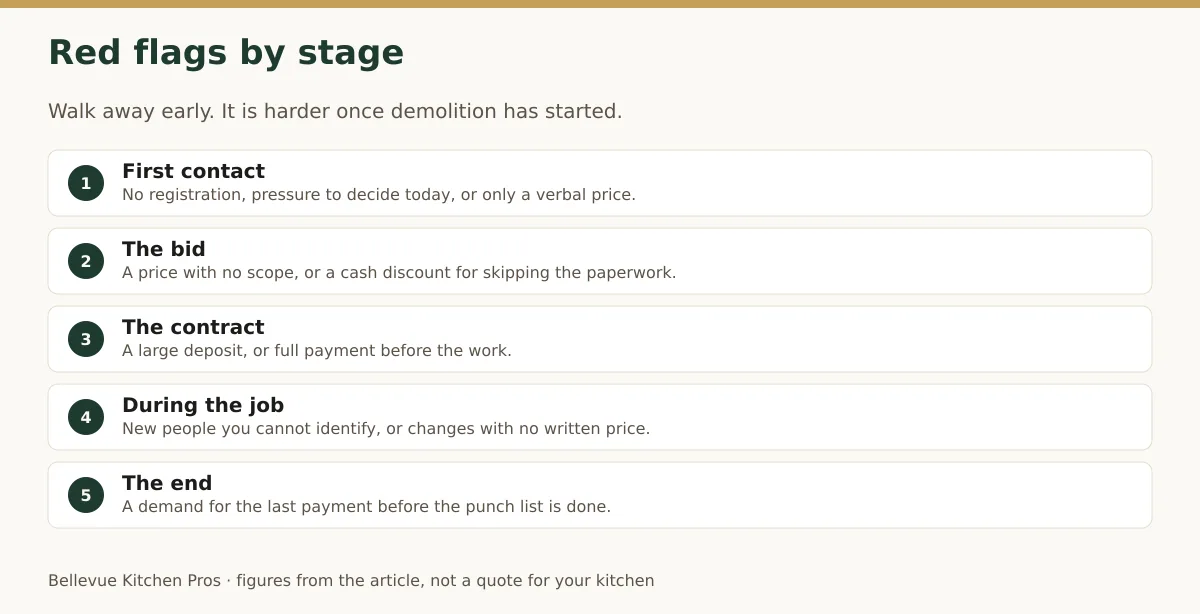
- 3Red flags at the first contact
- 4Red flags in the bid
- 5Red flags in the contract
- 6Red flags during the job
- 7Red flags in older homes
- 8Red flags at the end of the job
- 9Contractor scams in Washington: common patterns
- 10Permits: a red flag homeowners often miss
- 11Red flags in reviews and online listings
- 12Green flags: what good looks like
- 13What to do if you already hired a bad contractor
- 14Trust the timeline, not the promises
- 15How we make it easy to check us
- 16FAQs
- 17Trust the paperwork, not the pitch
A bad contractor rarely looks bad at first. They are friendly, fast to reply and often the cheapest.
The warning signs show up in what they ask for and what they avoid. Here is what to watch for at each stage.
What are the biggest contractor red flags?
The biggest contractor red flags are no written contract, cash-only payment and large deposits. Pressure to sign today is another. So is asking you to pull the permit, or credentials you cannot verify. Washington L&I lists each of these as warning signs.
You can read L&I’s full list on its Hire Smart page. Spotting one is a reason to slow down. Spotting two or more is a reason to walk away.
L&I’s official red flags
Washington L&I publishes a list of red flags for homeowners. These come straight from the state.
| Red flag (Washington L&I) | Why it matters |
|---|---|
| “Does not provide a written contract or complete bid.” | You have no proof of what was promised |
| “Only accepts cash, require large deposits or the entire cost up-front” | Your money gets ahead of the work |
| Credentials or references you cannot verify | They may not be registered, bonded or insured |
| A special price only if you sign today | Pressure replaces a fair comparison |
| Asks you to get the building permit | They may be avoiding registration checks |
| Offers exceptionally long warranties | Big promises with nothing behind them |
| Wants most work done on weekends or after hours | May signal side jobs or unregistered work |
| Asks to be paid in their own name, not the business name | Weakens your paper trail and protections |
| An offer that sounds “too good to be true” | Usually means missing scope or shortcuts |
Red flags at the first contact
Watch for pressure, vague answers and missing details from the very first call or visit.
Signs of a bad contractor early on:
- No registration number. They cannot or will not give their L&I number.
- Door-to-door offers. “We have leftover material from a job down the street.”
- High-pressure timing. The price is only good today.
- No business address. Only a cell phone and a first name.
- No questions about your home. A good remodeler asks about age, layout and goals.
Check every contractor on the free L&I Verify tool before you go further. Our guide on how to verify contractor registration in Washington walks through it.
Red flags in the bid
A bid that is vague, missing key costs or far below the others deserves a hard look.
Kitchen remodeler red flags in a bid:
- A one-line price. “Kitchen remodel: $40,000” with no breakdown.
- No sales tax. Washington sales tax applies to the full contract price.
- No permits listed for work that needs them, like moving gas lines or circuits.
- No allowances for items you have not picked yet.
- A price far below every other bid with no clear reason.
A low price is not always a scam. Sometimes it just leaves things out. Ask the low bidder to match the others line by line. If they cannot, you have your answer.
Red flags in the contract
If the contract is missing key items, do not sign until it is fixed.
Contract warning signs:
- No written contract at all, or a contract that just says “per discussion.”
- No disclosure statement. Washington requires it before work starts on residential jobs of $1,000 or more.
- A payment schedule that front-loads the money.
- No change order process. Every change should be written and priced.
L&I advises homeowners to “Avoid verbal contracts or amendments.” A contractor who resists putting things in writing is telling you something.
Red flags during the job
Once work starts, watch for skipped inspections and vanishing crews. Watch for payment requests that run ahead of the work.
- Covering work before inspection. Bellevue requires work to be inspected before it is covered.
Other warning signs during the build:
- The crew shows up less often after a payment clears.
- Change orders appear without paperwork.
- Subs say they have not been paid.
- The schedule slips with no clear reason.
- They ask for “a little extra cash” outside the contract.
An unpaid sub or supplier may be able to file a lien on your home. L&I advises collecting lien releases from major subs and suppliers as you pay.
Red flags in older homes
In a pre-1978 home, a contractor who shrugs off lead paint or asbestos is a red flag.
Many Bellevue neighborhoods date from the late 1950s to the 1980s. That makes these questions common.
Watch for:
- No lead-safe certification for work in a pre-1978 home. The EPA requires it for paid work that disturbs paint.
- Plans to sand or demolish old paint with no containment.
- “We don’t need to test” for old vinyl flooring or patching compounds.
- No plan for wiring or plumbing that may fail inspection once exposed.
The EPA says that if you suspect a material contains asbestos, “don’t touch it.” A good contractor builds testing into the plan before demolition.
Red flags at the end of the job
The last payment is your strongest tool. Watch for pressure to pay it before the work is done.
Warning signs at closeout:
- A push for final payment before the final inspection
- No punch list walkthrough
- No final lien releases
- No written warranty, or a warranty that differs from the contract
L&I advises avoiding full payment until all work is complete and you are satisfied.
Contractor scams in Washington: common patterns
Most contractor scams follow a few patterns. They take a deposit and vanish, start and stall, or skip permits.
| Pattern | How it looks | How to avoid it |
|---|---|---|
| Deposit and disappear | Large deposit, then no work | Small deposit, pay by phase |
| Start and stall | Demolition, then long gaps | Written schedule, phase payments |
| Unpermitted work | “You don’t need a permit for this” | Check Bellevue permit rules |
| Bait and switch | Cheaper materials than quoted | Product list with models in the contract |
| Fake credentials | A registration that does not check out | Verify on L&I yourself |
L&I runs a Report-a-Fraud line at 1-888-811-5974 if you suspect unregistered or fraudulent contracting.
Permits: a red flag homeowners often miss
A contractor who skips the permit, or asks you to pull it, may be dodging the City’s check.
In Bellevue, the City says it “cannot issue a building permit without verifying that the contractor is currently registered.” That is one reason a contractor might ask you to pull it.
Some kitchen work needs no building permit. Bellevue does not require one to replace cabinets or countertops. But moving a gas line, adding circuits, moving plumbing fixtures or changing structure does.
If you are unsure, check the City of Bellevue permit FAQ yourself.
Red flags in reviews and online listings
Reviews help, but they can mislead. Look for patterns, not star counts.
Things that should make you look closer:
- Many five-star reviews posted in a short time, with no detail
- Photos that appear on other companies’ sites
- A business name that differs from the L&I record
- No physical address anywhere online
Compare what you see online with the L&I record. The business name, owner and registration should match.
Green flags: what good looks like
Good contractors make checking easy. They share documents, put everything in writing and explain how they handle problems.
Signs of a solid kitchen remodeler:
- They give their L&I number without being asked.
- The bid is itemized, with tax, permits and allowances.
- The contract includes a phase-based payment schedule.
- They pull permits in their own name.
- They give you the disclosure statement before work starts.
- References describe problems and how they were fixed.
What to do if you already hired a bad contractor
Stop paying, document everything and contact L&I. You may be able to claim against the contractor’s bond.
L&I says that if you cannot resolve serious problems, “you can file suit against their bond.” Some homeowners may also qualify for the state Homeowner Recovery Fund.
For next steps, see what to do if a contractor abandoned the job in Washington.
Trust the timeline, not the promises
A good contractor gives you time to compare. Pressure to decide fast is a warning sign on its own.
Take a few days to check registration, call references and read the contract. If the offer disappears because you asked for time, it was not a good offer.
How we make it easy to check us
Bellevue Kitchen Pros plans and builds kitchens from start to finish. We share our registration and insurance details up front.
Your bid is itemized. Your contract includes the scope, a product list and the price with tax. Payments follow finished phases. We pull permits in our name and give you the disclosure statement before work starts.
Learn more about our approach to kitchen remodeling in Bellevue.
FAQs
What are signs of a bad contractor?
Common signs include no written contract, cash-only payment and large deposits. Pressure to sign today and unverifiable credentials are others. Asking you to get the building permit is another. Washington L&I lists each of these. Check any contractor on the L&I Verify tool before you sign.
Is a very low bid a red flag?
It can be. A low bid often leaves out sales tax, permits, allowances or prep work. It may also use cheaper materials. L&I warns about offers that sound too good to be true. Ask the low bidder to match the other bids line by line. If they cannot explain the gap, be careful.
Should a contractor ask me to pull the permit?
No. L&I lists this as a red flag. In Bellevue, the City checks contractor registration before it issues a building permit. A contractor who wants you to pull the permit may be avoiding that check. The registered contractor should pull permits in their own name.
How do I report a bad contractor in Washington?
Contact Washington L&I. You can report unregistered or fraudulent contracting through its Report-a-Fraud line at 1-888-811-5974 or online. For a dispute with a registered contractor, L&I explains how to sue the bond. A lawyer can help with larger claims.
Is a contractor who only works weekends a red flag?
L&I lists wanting most work done on weekends or after hours as a red flag. It can signal side jobs or unregistered work. Bellevue also limits construction noise on Sundays and legal holidays. Ask why, check registration and confirm the schedule in the written contract.
Trust the paperwork, not the pitch
Contractor red flags show up in what a contractor will not put in writing. Verify registration, insist on a full bid and contract, and pay only as work is finished.
Book a consultation and see what a complete bid and contract look like for your Bellevue kitchen.
Written by
Daniel Brooks
Daniel Brooks has worked in kitchen remodeling since 2020. He leads the planning guides at Bellevue Kitchen Pros and focuses on Bellevue kitchen remodels: how layouts, cabinets and counters fit local homes, what the City of Bellevue requires for permits, and how costs break down from a minor refresh to a full remodel. He writes in plain steps, links every figure to its source, and updates guides when local rules or prices change.
Planning notes are general. Confirm engineering, permits, and price with a licensed Washington contractor.


