
On this page
- 1How do you verify contractor registration in Washington?
- 2Why registration matters
- 3Step by step: how to check a contractor’s license in Washington
- 4What the L&I lookup shows
- 5Contractor bond in Washington: how much is required?
- 6Required liability insurance
- 7Registration, licensing and certification: what is the difference?
- 8How to read claims against a bond
- 9Check the subcontractors and trades
- 10Match the business on every document
- 11What to do if the contractor is not registered
- 12Other checks to pair with the L&I lookup
- 13What if something goes wrong later?
- 14Keep a record of what you checked
- 15How we make checking easy
- 16FAQs
- 17Two minutes that protect your kitchen
A business card and a nice truck prove nothing. Some people doing remodels in Washington are not registered at all.
If they are not, you lose key protections. Checking takes about two minutes.
How do you verify contractor registration in Washington?
Go to the free Washington L&I Verify tool at secure.lni.wa.gov/verify. Search by business name, owner name or registration number. Confirm the registration is active. Then check the bond, the insurance and any lawsuits against the bond.
You can open the L&I Verify tool here. It is free and needs no account.
Why registration matters
Washington requires construction contractors to register with L&I. Registration comes with a bond and liability insurance, which protect you if things go wrong.
In Bellevue, registration is not optional. The City says, “Any contractor conducting business in the city must be licensed by the State of Washington Department of Labor and Industries.”
The City also says it “cannot issue a building permit without verifying that the contractor is currently registered.” That rule appears on its contractor registration FAQ.
Hiring an unregistered contractor carries a direct cost. The City warns that an owner who uses one “will not be protected by the contractor’s bond.”
Step by step: how to check a contractor’s license in Washington
The whole check takes a few minutes. Do it for every contractor before you sign anything.
- Get the details. Ask for the exact business name and L&I registration number.
- Open the Verify tool at secure.lni.wa.gov/verify.
- Search by registration number if you have it. It gives the most exact match.
- Confirm the name. The business name should match the bid and contract.
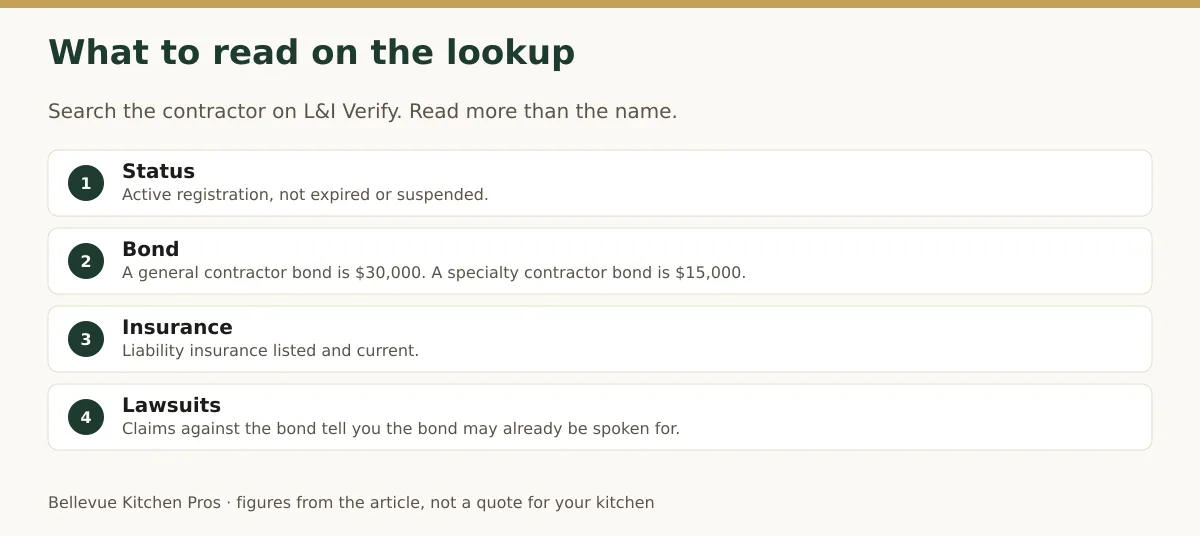
- Check the status. It should say active, not expired or suspended.
- Check the bond. Note the bond company and amount.
- Check insurance. Note the insurer and expiration date.
- Check for lawsuits against the bond and safety violations.
- Save a screenshot with the date for your records.
Bellevue’s permit portal, MyBuildingPermit, also links to the same L&I lookup. So does the City’s permit help.
What the L&I lookup shows
The Verify tool shows registration status, bond and insurance details, lawsuits against the bond and safety violations.
L&I says the tool shows whether a business “has an active contractor registration.” It also shows workers’ comp coverage for employees. It also shows “safety violations, other information, lawsuits against their surety bond and more.”
| What you see | What to look for | Red flag |
|---|---|---|
| Registration status | Active | Expired, suspended or not found |
| Business name | Matches your bid | A different name or no match |
| Bond | Current bond on file | No bond or a cancelled bond |
| Insurance | Current policy on file | Expired or missing |
| Lawsuits against bond | None, or resolved | Several open claims |
| Workers’ comp | Active account if they have employees | No account but a crew on site |
| Safety violations | None or minor | Repeated serious citations |
Contractor bond in Washington: how much is required?
Washington requires a $30,000 bond for general contractors and a $15,000 bond for specialty contractors.
Those amounts come from RCW 18.27.040. A general contractor runs whole projects. A specialty contractor works in one trade, like painting or flooring.
A kitchen remodeler who manages several trades should usually carry the general contractor bond.
Keep in perspective what a bond does. It is a limited fund. Many people can claim against the same bond, so it may not cover your whole loss.
Required liability insurance
Registered contractors must carry liability insurance with set minimums under RCW 18.27.050.
| Coverage | Minimum |
|---|---|
| Damage to property | $50,000 |
| Injury or death, one person | $100,000 |
| Injury or death, more than one person | $200,000 |
Liability insurance covers damage the contractor causes to your property or to people. It does not cover poor workmanship by itself.
Ask for a certificate of insurance sent straight from the insurer. Check that the dates cover your whole project.
Registration, licensing and certification: what is the difference?
Washington registers general contractors rather than licensing them by exam. Some trades, like electricians and plumbers, need separate certification.
People often say “licensed contractor.” In Washington, the general contractor step is registration with L&I, backed by a bond and insurance.
Electricians and plumbers have their own certification rules. The same Verify tool lets you look up a tradesperson’s certificate.
For older homes, ask one more question. Paid crews who disturb paint in homes built before 1978 must be lead-safe certified. In Washington, the Department of Commerce runs that program.
How to read claims against a bond
One old, resolved claim is not always a deal breaker. Several open claims, or recent ones, are a serious warning.
When you see a lawsuit against the bond, look at three things:
- Date. Is it recent or many years old?
- Status. Is it open, settled or dismissed?
- Pattern. Is it one claim, or several from different homeowners?
Then ask the contractor about it directly. A good contractor explains what happened and how it was resolved. A vague or angry answer tells you something too.
Remember that every claim draws on the same limited bond. Open claims can leave less money for anyone else.
Check the subcontractors and trades
Your general contractor should be registered, and so should every subcontractor on your job. Electricians and plumbers also need their own trade certification.
Ask your contractor which trades they subcontract. Common ones in a kitchen are electrical, plumbing, drywall, counters and tile.
Look up each company name on the same Verify tool. It also has a subcontractor lookup and a tradesperson certificate search.
This matters for liens too. Subcontractors and suppliers who are not paid can file a lien on your home. L&I advises asking for a completed lien release from all major subcontractors and suppliers.
Match the business on every document
The registration name should match the bid, the contract, the permit and your checks. A mismatch is a warning sign.
Check these line up:
- The business name and registration number on the bid
- The same name on the contract
- The contractor named on the permit
- The payee on every check or transfer
L&I flags a contractor who wants payment in their own name, not the business name. Pay the business, not the person.
What to do if the contractor is not registered
Do not hire them. Ask for the correct name or number once, then move on if the record is missing.
An honest mistake is possible. The business may use a trade name, or you may have the wrong spelling. Ask them for their exact registration number.
If there is still no record, walk away. You would lose bond protection. In Bellevue, the City also cannot issue them a building permit.
You can also report unregistered contracting to L&I. Its Report-a-Fraud line is 1-888-811-5974.
Our post on hiring an unlicensed contractor in Washington explains the risks in detail.
Other checks to pair with the L&I lookup
Registration is the minimum, not the whole check. Pair it with references, a site visit and a full written bid.
What works:
- Call recent references and ask how problems were handled.
- Visit a current job site to see how they work.
- Get a written, itemized bid with tax and permits shown.
- Confirm who pulls permits. It should be the contractor.
- Check the record again right before you sign.
Common mistakes:
- Checking once early, then signing months later without rechecking.
- Accepting a photo of a registration card instead of looking it up.
- Ignoring a long list of claims against the bond.
L&I lists other warning signs too. One is a contractor who asks you to get the building permit. Another is a request to pay in the owner’s own name instead of the business name.
For the full process, see how to hire a contractor for a kitchen remodel.
What if something goes wrong later?
If a registered contractor leaves work unfinished or does poor work, you may sue against their bond. Some homeowners may also qualify for the state Homeowner Recovery Fund.
L&I’s Homeowner Recovery Fund can pay “up to $25,000, depending on available funds.” To qualify, you must own and occupy the home. The contractor must have been registered. Condominiums are excluded.
That is one more reason to hire only registered contractors. These protections depend on it.
Keep a record of what you checked
Save what you find. It helps if you need to make a claim later.
Keep a folder with the L&I screenshot, the certificate of insurance, the bid and the signed contract. Note the date you checked each one. Recheck the record right before you sign.
How we make checking easy
Bellevue Kitchen Pros plans and builds kitchens from start to finish. We share our L&I registration number and insurance details before you sign anything.
We pull permits in our own name for the work that needs them. Your contract lists the scope, the price with tax and a payment schedule tied to finished phases.
Learn more about our approach to kitchen remodeling in Bellevue.
FAQs
How do I check a contractor’s license in Washington?
Use the free L&I Verify tool at secure.lni.wa.gov/verify. Search by registration number, business name or owner name. Confirm the registration is active and the name matches your bid. Then review the bond, insurance, lawsuits against the bond and any safety violations. Save a dated screenshot.
What bond does a Washington contractor need?
Under RCW 18.27.040, a general contractor must carry a $30,000 bond. A specialty contractor, who works in one trade, must carry a $15,000 bond. The bond is a limited fund. Several people can claim against it, so it may not cover a large loss on its own.
Can I hire an unregistered contractor in Bellevue?
You should not. Bellevue cannot issue a building permit without verifying the contractor is registered. The City also warns that you lose the contractor’s bond protection. You may also lose access to the state Homeowner Recovery Fund.
How often is the L&I Verify tool updated?
L&I updates the contractor data regularly, so check close to the day you sign. A registration can lapse or a bond can be cancelled between your first meeting and the contract. Checking twice, once early and once right before signing, is a simple habit that protects you.
Is a contractor’s business license the same as L&I registration?
No. A city or state business license lets a company do business. L&I contractor registration is the step that comes with the required bond and insurance. Bellevue checks L&I registration before it issues a building permit. Always confirm registration on the L&I Verify tool, not just a business license.
Two minutes that protect your kitchen
To verify contractor registration in Washington, search L&I and confirm active status. Then review the bond, insurance and claims. Do it for every bidder, every time.
Book a consultation and we will send our registration and insurance details with your estimate.
Written by
Daniel Brooks
Daniel Brooks has worked in kitchen remodeling since 2020. He leads the planning guides at Bellevue Kitchen Pros and focuses on Bellevue kitchen remodels: how layouts, cabinets and counters fit local homes, what the City of Bellevue requires for permits, and how costs break down from a minor refresh to a full remodel. He writes in plain steps, links every figure to its source, and updates guides when local rules or prices change.
Planning notes are general. Confirm engineering, permits, and price with a licensed Washington contractor.