

On this page
- 1What is a construction lien for a Washington homeowner?
- 2How a mechanics lien works in Washington
- 3Washington lien deadlines
- 4The Disclosure Statement Notice to Customers
- 5How to protect yourself from a construction lien
- 6What is a lien release in Washington?
- 7Subcontractor lien on my house: what to do
- 8Notices from suppliers during the job
- 9Joint checks: another way to pay safely
- 10What a lien means for selling or refinancing
- 11If your contractor stops paying their subs
- 12Common lien mistakes
- 13Put lien protection in the contract
- 14Lien checklist at final payment
- 15How we keep your home lien-free
- 16FAQs
- 17Protect your home as you pay
You paid your contractor in full. Then a letter arrives from a cabinet supplier you have never met. They say they may put a lien on your home.
It happens more than people think. And it is mostly preventable.
What is a construction lien for a Washington homeowner?
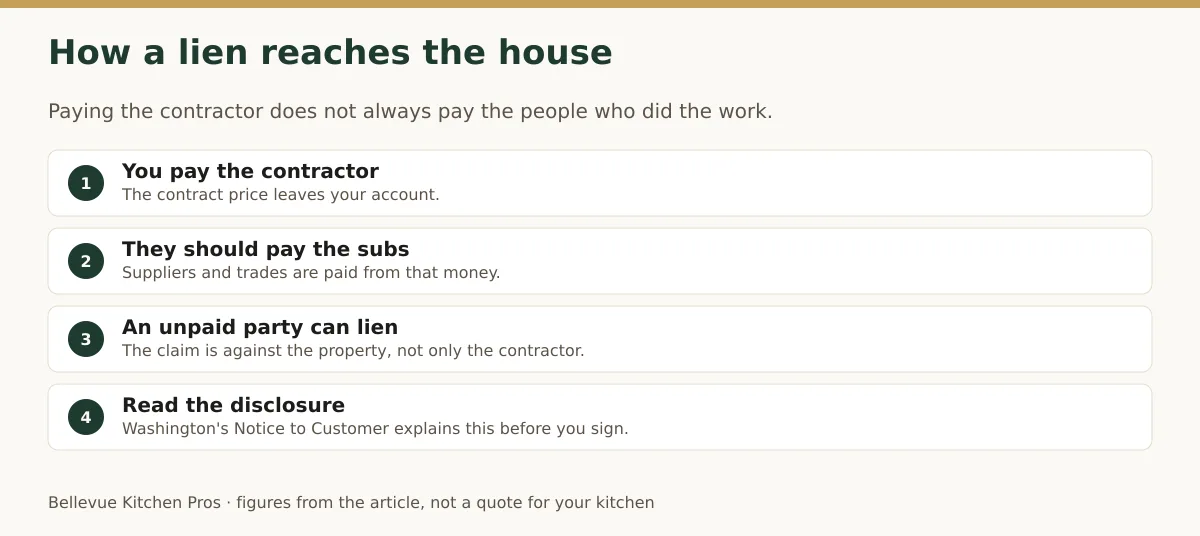
A construction lien is a legal claim against your property. It comes from someone who did work or supplied materials and was not paid. In Washington, a sub or supplier can lien your home even if you paid your contractor. That is how homeowners end up paying twice.
Washington’s required contractor notice says it plainly: “your property may be liened to force payment and you could pay twice for the same work.” That wording comes from RCW 18.27.114.
How a mechanics lien works in Washington
A lien gives an unpaid worker or supplier a claim on the property they improved. Washington sets strict deadlines for filing one.
People often call it a mechanics lien. The idea is simple. If someone adds value to your home and is not paid, they can claim against the home.
Here is how the money usually flows in a kitchen remodel:
- You pay your general contractor.
- Your contractor pays the subs, like the electrician and counter shop.
- Your contractor or subs pay suppliers, like the cabinet distributor.
If step 2 or 3 breaks, the unpaid party can look to your home. You never signed anything with them, but the lien can still attach.
Washington lien deadlines
A lien must be recorded within 90 days after the person stops furnishing labor or materials. The claimant must send the owner a copy within 14 days of filing.
| Rule | What it says | Source |
|---|---|---|
| Filing deadline | “not later than ninety days after the person has ceased to furnish labor, professional services, materials, or equipment” | RCW 60.04.091 |
| Copy to owner | Within 14 days of the lien being filed for recording | RCW 60.04.091 |
| Contractor notice | Required before work starts on residential jobs of $1,000 or more | RCW 18.27.114 |
L&I summarizes the timing the same way: “A lien may be filed within 90 days of work stoppage or delivery of materials.”
That means the risk window can run months after your kitchen is done. A supplier who delivered cabinets in March could file into June.
The Disclosure Statement Notice to Customers
Washington contractors must give you a disclosure statement before residential work of $1,000 or more. It explains lien rights.
The notice is meant to warn you early. It says your property may be liened and you could pay twice.
The law backs this up. Under RCW 18.27.114, a contractor cannot bring a lien claim unless they prove they gave it. Failing to give it is also an infraction.
Make sure you receive it before work begins. Keep a signed copy with your contract.
How to protect yourself from a construction lien
Collect lien releases as you pay, pay by phase and know who is working on your job. Those three habits prevent most lien problems.
Seven steps that work:
- Get the disclosure statement before work starts.
- Ask for a list of subs and suppliers on your project.
- Pay by phase, never far ahead of the work.
- Collect lien releases from major subs and suppliers with each payment.
- Consider a performance bond on projects over $6,000.
- Pay the business, not a person, by check or traceable transfer.
- Keep every document: contract, invoices, releases and change orders.
L&I advises you to “request a completed lien release from all major subcontractors and suppliers.” It also says to consider a performance bond when a project costs more than $6,000.
What is a lien release in Washington?
A lien release is a signed document from a sub or supplier. It says they were paid and give up lien rights for that work.
There are two common types:
| Type | What it covers | When to collect |
|---|---|---|
| Partial or progress release | Payment for work up to a set date or amount | With each progress payment |
| Final release | All work and materials on the job | Before the final payment |
Read each release before you file it. Check the company name, the project address, the amount and the dates.
Subcontractor lien on my house: what to do
If you receive a lien notice, take it seriously. Tell your contractor right away and find out how they plan to pay the sender.
L&I gives clear advice: “If you receive a lien notice, take it seriously. Let your contractor know you have received the notice.” It also says to find out what arrangements the contractor has made to pay the sender.
Steps to take:
- Read the notice and note the sender, the amount and the dates.
- Contact your contractor in writing and ask for proof of payment.
- Hold your next payment until the issue is resolved, if your contract allows.
- Ask for a lien release from the sender once they are paid.
- Talk to a lawyer if a lien is recorded or the contractor does not respond.
Do not ignore a lien notice. A recorded lien can complicate a sale or refinance.
Notices from suppliers during the job
Some suppliers send an early notice that they are providing materials to your project. It is information, not a lien.
A notice like this tells you who is on your job. That is useful. It gives you a name to collect a lien release from later.
When one arrives:
- Add the sender to your list of subs and suppliers.
- Ask your contractor to confirm how that supplier will be paid.
- Collect a release from that supplier before your final payment.
Joint checks: another way to pay safely
A joint check is made out to both your contractor and a sub or supplier. Both must sign it, so the sub or supplier sees the money.
Joint checks can help on large purchases, like a cabinet order or a counter slab. They add a step, so agree on them in the contract first.
Pair them with a lien release for that payment. The release proves the sub or supplier was paid.
What a lien means for selling or refinancing
A recorded lien is a claim on your title. Buyers and lenders usually want it cleared before closing.
Selling or refinancing soon after a remodel? Collect final lien releases before the last payment. That keeps the title clean.
If a lien is recorded, a title company or lawyer can explain your options. This post is general information, not legal advice.
If your contractor stops paying their subs
Stop payments, document what you have paid and contact L&I. You may be able to claim against the contractor’s bond.
L&I says that if you cannot resolve serious problems with a contractor, “you can file suit against their bond.” Washington requires a $30,000 bond for general contractors.
Some owners may also qualify for the Homeowner Recovery Fund. It can pay up to $25,000, depending on available funds, if you meet its rules.
Common lien mistakes
Most lien problems come from paying ahead, skipping releases or not knowing who supplied the job.
Mistakes to avoid:
- Paying in full before collecting final lien releases
- Not asking who the subs and suppliers are
- Ignoring a preliminary notice from a supplier
- Paying in cash with no record
- Signing a contract with no disclosure statement
Liens connect closely to how you pay. Our guide on kitchen remodel deposits and payment schedules shows a schedule that keeps your risk low.
Put lien protection in the contract
Your contract should require lien releases with each payment and list the major subs and suppliers.
Add these lines to your contract:
- The contractor will provide lien releases from major subs and suppliers with each payment request.
- Final payment is due after final lien releases are delivered.
- The contractor will list the subs and suppliers on the project.
For the full list of contract items, see our kitchen remodel contract checklist.
Lien checklist at final payment
Before the last check, confirm every major sub and supplier has been paid.
- Final lien releases from the general contractor
- Final releases from major subs, like electrical, plumbing and counters
- Final releases from major suppliers, like cabinets and appliances
- A copy of the passed final inspection
- A signed punch list
File all of it with your contract. It protects you if a question comes up later.
How we keep your home lien-free
Bellevue Kitchen Pros plans and builds kitchens from start to finish. We give you the Washington disclosure statement before work starts.
Each payment request comes with lien releases from the major subs and suppliers paid in that phase. Final releases come before the final payment.
Learn more about how we handle kitchen remodeling in Bellevue.
FAQs
Can a subcontractor put a lien on my house if I paid the contractor?
Yes. In Washington, an unpaid sub or supplier can lien your home even if you paid your contractor. That is why the state’s required notice warns you could pay twice. Collecting lien releases from major subs and suppliers with each payment is the best protection.
How long does a contractor have to file a lien in Washington?
Under RCW 60.04.091, a lien must be recorded within 90 days. The clock starts when the person stops furnishing labor or materials. The claimant must also give the owner a copy within 14 days of filing. Watch for notices during the job and for a few months after.
How do I get a lien removed in Washington?
The simplest way is for the claimant to be paid and sign a lien release. Ask your contractor to resolve the debt and deliver the release. If the lien is disputed or the contractor will not act, talk with a Washington construction lawyer.
Do I need lien releases for a small kitchen job?
Collect them whenever a sub or supplier works on the job. Small jobs carry less money at risk, but the rule is the same. The required disclosure statement applies to residential work of $1,000 or more. Ask for releases from major subs and suppliers before you make the final payment.
Does a lien mean I have to pay twice?
Not automatically, but it can lead there. A lien is a claim on your property, not a bill you must pay on the spot. If it is valid and not resolved, it can force payment from the property. Collecting lien releases and paying by phase are the best ways to avoid that outcome.
Protect your home as you pay
A construction lien is a real risk for any Washington homeowner who remodels. Get the disclosure, pay by phase and collect lien releases, and you will almost never pay twice.
Book a consultation. We will show you how lien releases fit into every payment.
Written by
Daniel Brooks
Daniel Brooks has worked in kitchen remodeling since 2020. He leads the planning guides at Bellevue Kitchen Pros and focuses on Bellevue kitchen remodels: how layouts, cabinets and counters fit local homes, what the City of Bellevue requires for permits, and how costs break down from a minor refresh to a full remodel. He writes in plain steps, links every figure to its source, and updates guides when local rules or prices change.
Planning notes are general. Confirm engineering, permits, and price with a licensed Washington contractor.