
On this page
- 1How do you compare contractor bids?
- 2Why are contractor quotes so different?
- 3Step 1: Send every bidder the same scope
- 4Step 2: Build a bid leveling table
- 5Step 3: Fill the gaps
- 6Step 4: Compare allowances fairly
- 7Sanity-check line items against published ranges
- 8Step 5: Compare more than price
- 9Is a much lower quote a red flag?
- 10Questions to ask about any bid
- 11How to compare a design-build price to a contractor bid
- 12Check registration before you decide
- 13Tips for a cleaner comparison
- 14Bid red flags vs green flags
- 15How long a bid takes and stays valid
- 16Use one folder for every bid
- 17What our bids look like
- 18FAQs
- 19Level first, then decide
You asked three contractors to bid your kitchen. The prices are thousands of dollars apart, and each bid is laid out differently.
That is normal. The bids are probably not for the same kitchen yet.
How do you compare contractor bids?
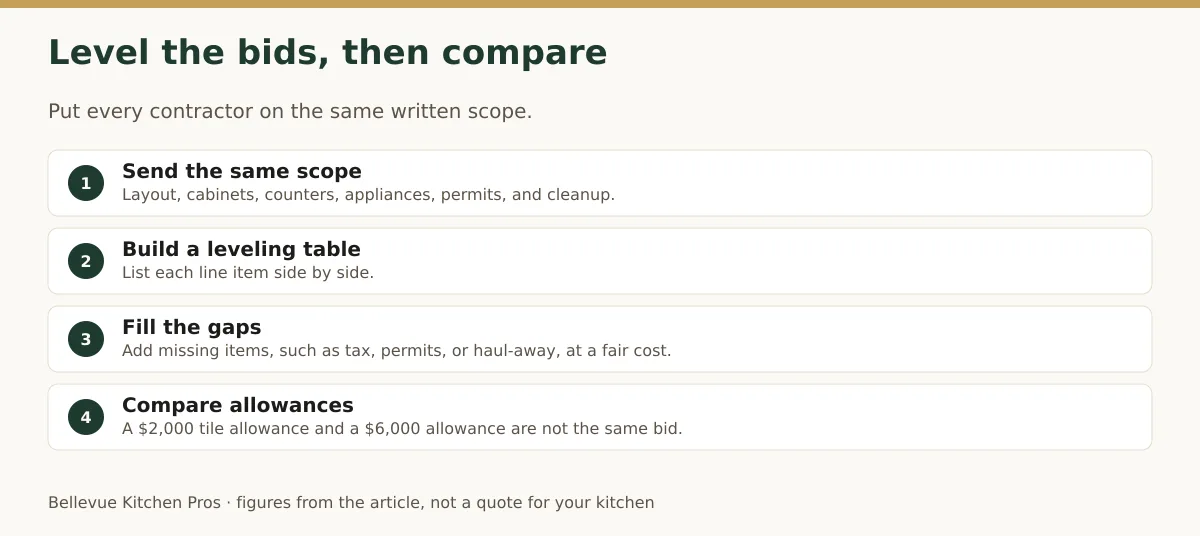
To compare contractor bids, put every bid on the same scope first. List each line item side by side and mark what each bid leaves out. Add missing items at a fair cost. Only then compare the totals. This is called bid leveling.
Washington L&I advises homeowners to “interview several qualified, registered contractors/remodelers and get your bids in writing.” Its Hire Smart page is a good starting point.
Why are contractor quotes so different?
Most big gaps come from different scopes, different product grades and different exclusions. True price differences for the same work are usually smaller.
Common reasons bids differ:
- Different cabinet grades. Stock, semi-custom and custom vary widely.
- Different counter material or edge profile.
- Missing items. Tax, permits, haul-away or appliance install.
- Different allowances. One bid allows $2,000 for tile, another $6,000.
- Different assumptions about what is behind the walls.
- Different overhead. Supervision, insurance and warranty.
A low bid may simply leave things out. A high bid may include things you did not ask for.
Step 1: Send every bidder the same scope
The best way to compare kitchen remodel bids is to make them comparable before they arrive. Give every contractor the same written scope.
Your scope sheet should list:
- Layout: what stays and what moves
- Cabinets: type, door style and finish
- Counters: material and edge
- Sink, faucet and backsplash
- Appliances: models, or who supplies them
- Flooring and lighting
- Who handles permits and inspections
- Haul-away and cleanup
Ask each bidder to show sales tax, permits and allowances as separate lines. In Washington, sales tax applies to the full contract price of a remodel.
Step 2: Build a bid leveling table
A bid leveling table lines up every bid by item. It shows at a glance what each one includes.
Here is a simple version you can copy. The dollar amounts are placeholders to show the method, not real prices.
| Line item | Bid A | Bid B | Bid C |
|---|---|---|---|
| Demolition and haul-away | Included | Included | Not listed |
| Cabinets (type) | Semi-custom | Stock | Semi-custom |
| Counters | Quartz | Quartz | Laminate |
| Plumbing and electrical | Included | Included | Included |
| Permits | Included | Not listed | Included |
| Tile allowance | $3,000 | $1,500 | $3,000 |
| Lighting allowance | $1,500 | None | $1,500 |
| Sales tax | Shown | Not shown | Shown |
| Repair allowance | Listed | None | Listed |
Mark each “Not listed” or “None” cell. Those are the gaps.
Step 3: Fill the gaps
For each missing item, ask the bidder to price it. Then add it to their total before you compare.
Send each contractor a short, written question:
- “Does your bid include permits? If not, what would they cost?”
- “Your bid does not show sales tax. Please confirm the total with tax.”
- “Can you quote semi-custom cabinets to match the other bids?”
Now each bid covers the same kitchen. The totals finally mean something.
Step 4: Compare allowances fairly
An allowance is a set amount for an item you have not picked yet. Low allowances make a bid look cheaper than it will end up.
If one bid allows $1,500 for tile and another allows $3,000, the first will likely grow. Set the same allowance for every bid, using what you expect to spend.
Ask what happens if you go over or under. A good contract spells that out.
Sanity-check line items against published ranges
Published cost ranges help you spot a line that looks far off. They do not replace a local quote.
HomeGuide gives these national ranges:
| Line item | National range (HomeGuide) |
|---|---|
| Full cabinet replacement | $4,500 to $15,000 |
| Countertops | $1,500 to $6,000 |
| Permits | $500 to $1,500 |
| Remove a load-bearing wall | $4,000 to $15,000 |
| Remove a non-load-bearing wall | $500 to $2,000 |
If a bid’s line is far outside a range, ask why. There may be a good reason, like custom cabinets or a large island. Or the line may be missing scope.
Costs that bids often skip are covered in our guide to the hidden costs of a kitchen remodel.
Step 5: Compare more than price
Once scopes match, weigh schedule, payment terms, warranty and paperwork alongside the price.
| Factor | What to compare |
|---|---|
| Schedule | Start date, completion date, phase plan |
| Payment schedule | Small deposit, then by finished phase |
| Change orders | Written and priced before work |
| Warranty | What is covered and for how long |
| Permits | Who pulls them, and in whose name |
| Registration | Active L&I registration, bond and insurance |
L&I advises: “Besides a reasonable down payment, you should pay your contractor only when specific phases of a project are completed.” Compare how each bid handles payments.
Is a much lower quote a red flag?
It can be. A quote far below the others often leaves out scope. It may use cheaper materials or skip permits.
L&I warns about offers that sound “too good to be true.” It also lists “Does not provide a written contract or complete bid” as a red flag.
Ask the low bidder to match the others line by line. If the price stays low and the scope matches, ask how. Sometimes there is a good reason, like a light schedule. Often there is not.
Questions to ask about any bid
If a line is vague, ask. A good contractor explains their bid plainly and in writing.
- What exactly is included in this line?
- Which products and models does this price assume?
- What is excluded from this bid?
- How do you price work found behind the walls?
- How long is this price good for?
- Does the total include sales tax and permits?
Keep the answers with the bid. They become part of what you compare.
How to compare a design-build price to a contractor bid
A design-build price often includes design work and project management. A contractor bid may not. Add those costs before you compare.
If one firm designs and builds, and another only builds your plans, the scopes differ. HomeGuide’s national breakdown puts design at about 5% of a kitchen budget.
Make sure both prices cover the same finished kitchen. Then compare.
Check registration before you decide
Only compare bids from registered contractors. A bid from an unregistered contractor is not a real option in Bellevue.
The City of Bellevue “cannot issue a building permit without verifying that the contractor is currently registered.” Check each bidder on the free L&I Verify tool.
Look for active registration, a current bond and insurance, and any lawsuits against the bond.
Tips for a cleaner comparison
Ask the same questions, in writing, of every bidder. Keep notes in one place.
What works:
- Use one scope sheet for every contractor.
- Ask for itemized bids, not a single total.
- Ask for the same allowances on every bid.
- Put every answer in writing, including phone follow-ups.
- Check references for your top two bidders.
Common mistakes:
- Comparing totals before scopes match.
- Picking the lowest bid without checking what it leaves out.
- Letting one contractor’s suggestions change your scope for only that bid.
- Forgetting to confirm sales tax on every bid.
For the full hiring checklist, see the questions to ask a contractor for a kitchen remodel.
Bid red flags vs green flags
The way a bid is written tells you a lot about how the job will run.
| Red flag | Green flag |
|---|---|
| One-line total | Itemized lines by trade |
| No sales tax shown | Tax shown as its own line |
| No permits listed | Permits listed with who pulls them |
| No allowances | Allowances listed with amounts |
| Cash-only or large deposit | Small deposit, then by phase |
| “Price good today only” | A clear validity date |
L&I lists cash-only payment, large deposits and sign-today pressure as red flags.
How long a bid takes and stays valid
A detailed kitchen bid takes time to prepare, because the contractor must price cabinets, counters and trades.
Ask each contractor when you can expect the bid. Ask how long the price is good for, since material prices change.
If a bid expires before you decide, ask for an update in writing. Do not assume the old price holds.
Use one folder for every bid
Keep each bid, your leveling table and every written answer in one folder. It makes your final decision faster and gives you a record if questions come up later.
What our bids look like
Bellevue Kitchen Pros plans and builds kitchens from start to finish. Our bids are itemized, with sales tax, permits and allowances shown as separate lines.
That makes our bid easy to put in your leveling table next to any other. You see what is included and what is not.
Learn more about our approach to kitchen remodeling in Bellevue.
FAQs
How many bids should I get for a kitchen remodel?
Get at least three written bids from registered contractors. L&I advises interviewing several qualified, registered contractors and getting bids in writing. Three bids give you enough to see a pattern. More than five gets hard to compare without a strict scope sheet.
How do I compare kitchen remodel quotes that are very different?
First, make the scopes match. Line up each item side by side and mark what each quote includes or leaves out. Ask each contractor to price the missing items. Match the allowances. Then compare totals, schedule, payment terms and warranty. Big gaps usually shrink once scopes match.
Should I tell contractors what the other bids were?
You do not have to. It is fair to ask a contractor to explain a line or price a missing item. Sharing exact competitor prices can turn the talk into haggling instead of scope. Focus on making each bid complete and comparable.
What is bid leveling?
Bid leveling is the process of making bids comparable. You list every line item in a table and note what each bid includes. Then you price the gaps and set equal allowances. After leveling, the totals reflect the same scope. It is the clearest way to compare contractor bids.
Should I always pick the middle bid?
No. The middle bid is not always the best one. Pick the bid that covers your full scope and shows tax, permits and allowances. It should come from a registered contractor with solid references. After leveling, the best value may be the highest, lowest or middle price.
Level first, then decide
To compare contractor bids fairly, match the scope, fill the gaps and line up allowances. Then weigh price with schedule, payments and paperwork.
Book a consultation. You will get an itemized bid that fits right into your comparison.
Written by
Daniel Brooks
Daniel Brooks has worked in kitchen remodeling since 2020. He leads the planning guides at Bellevue Kitchen Pros and focuses on Bellevue kitchen remodels: how layouts, cabinets and counters fit local homes, what the City of Bellevue requires for permits, and how costs break down from a minor refresh to a full remodel. He writes in plain steps, links every figure to its source, and updates guides when local rules or prices change.
Planning notes are general. Confirm engineering, permits, and price with a licensed Washington contractor.