
On this page
- 1What are the hidden costs of a kitchen remodel?
- 2Why kitchen remodels go over budget
- 312 hidden costs of a kitchen remodel
- 4Sales tax on a kitchen remodel in Washington
- 5Permit fees
- 6Electrical and plumbing upgrades
- 7Lead paint and asbestos in older kitchens
- 8Why older Bellevue homes carry more risk
- 9Appliance and venting extras
- 10Structural and layout surprises
- 11Change orders: the most avoidable hidden cost
- 12How to build a kitchen remodel allowance
- 13How to protect your budget
- 14How we keep surprises out of your kitchen budget
- 15FAQs
- 16Plan for the costs you cannot see
Your quote looked fine. Then the walls came open and the change orders started.
Most budget overruns come from costs nobody wrote down at the start. You can plan for nearly all of them.
What are the hidden costs of a kitchen remodel?
The most common hidden costs are sales tax, permits and change orders. Electrical upgrades, plumbing and subfloor repairs, and lead or asbestos handling follow. In Bellevue, sales tax alone adds 10.3% to the full contract price.
Some of these are true surprises found behind walls. Others are simply left out of the first number you hear.
Why kitchen remodels go over budget
A kitchen packs plumbing, wiring, gas, venting and structure into one small room. You cannot see most of it until demolition.
On top of that, many early quotes are rough. They may skip tax, permits or allowances. The real number shows up later.
There are two kinds of hidden cost:
- Left-out costs. Known items missing from the quote, like tax or permits.
- Found costs. Problems no one could see until the walls opened.
You plan for the first kind by asking the right questions. You plan for the second with a written allowance.
12 hidden costs of a kitchen remodel
These are the extras that most often push a kitchen budget higher. Each one has a simple way to plan for it.
| Hidden cost | Why it shows up | How to plan for it |
|---|---|---|
| 1. Sales tax | Applies to the full contract price in Washington | Ask for a price with tax included |
| 2. Permit fees | Not always in the first quote | Ask if permits are included |
| 3. Electrical upgrades | New appliances may need new circuits | Check your panel during design |
| 4. Plumbing repairs | Old or worn pipes found at demolition | Ask for an allowance |
| 5. Subfloor damage | Leaks under the sink or dishwasher | Ask for an allowance |
| 6. Lead paint | Common in pre-1978 homes | Hire lead-safe certified crews |
| 7. Asbestos | Possible in old flooring and patching compounds | Test before demolition |
| 8. Structural work | Removing a wall may need an engineer | Price it before you commit |
| 9. Range hood venting | A bigger hood may need new ductwork | Pick the hood during design |
| 10. Appliance extras | Delivery, haul-away, install kits | Ask what is included |
| 11. Change orders | New choices once work starts | Decide everything before demolition |
| 12. Living costs | Eating out, extra trips | Set up a temporary kitchen |
Sales tax on a kitchen remodel in Washington
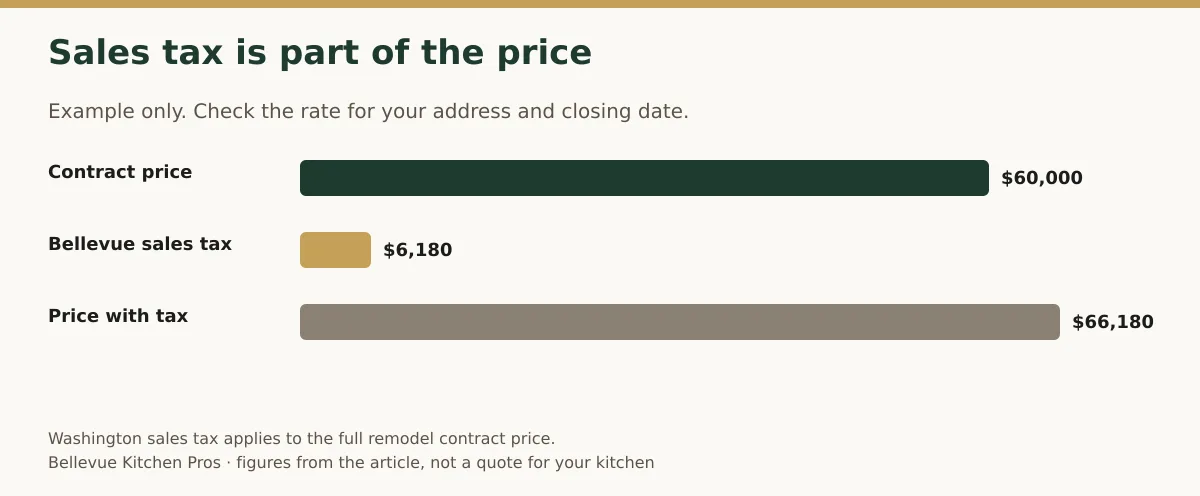
Washington retail sales tax applies to the full contract price of a remodel. In Bellevue, the combined rate is 10.3% for October through December 2026.
The Washington Department of Revenue publishes the rate each quarter. Rates can change, so check by your address before you sign.
On a $60,000 contract, 10.3% is $6,180. That is not a small line to miss.
Washington L&I also says a contract should state the “Price, including sales tax.” If a quote does not mention tax, ask.
Permit fees
Permit fees are a real cost, and some quotes leave them out. HomeGuide puts kitchen permits at $500 to $1,500 nationally. It says most contractor bids include them.
In Bellevue, you do not need a building permit to replace cabinets or countertops. You do need permits to move gas lines, add circuits, move fixtures or change structure.
Bellevue’s 2026 fees are set in a City ordinance. Ask your contractor which permits your job needs and whether the quote covers them.
Electrical and plumbing upgrades
New appliances and lighting often need new circuits. Old pipes found during demolition may need replacing. Both are common in older homes.
Watch for these:
- An induction range or new oven that needs a dedicated circuit
- A panel with no room for new circuits
- Old wiring that will not pass inspection once exposed
- Galvanized or worn pipes under the sink
- Water damage in the subfloor near the dishwasher
Bellevue requires a permit to add or move circuits or change the panel. HomeGuide lists electricians at $50 to $130 per hour. Plumbers run $45 to $150 per hour.
Lead paint and asbestos in older kitchens
Homes built before 1978 are more likely to have lead paint. Older flooring and patching compounds may contain asbestos. Both change how demolition is done.
The EPA says: “If your home was built before 1978, it is more likely to have lead-based paint.” Paid crews who disturb paint in those homes must be lead-safe certified.
For asbestos, the EPA’s asbestos guidance suggests an inspection before you remodel. It also says “Taking samples yourself is not recommended.”
Testing before demolition costs less than stopping work mid-job. Our guide to lead paint in a kitchen remodel covers the rules in Washington.
Why older Bellevue homes carry more risk
Older homes hide more surprises. Many Bellevue neighborhoods date from the late 1950s to the 1980s. Wiring, pipes and finishes may be original.
The City’s neighborhood profiles give a sense of age. Lake Hills was “originally developed in the late 1950s as a planned community.” Most homes in western Northeast Bellevue were built in the late 1960s, 1970s and 1980s. Northwest Bellevue includes some of the city’s oldest neighborhoods.
Homes from those decades may have:
- Paint layers that include lead, in homes built before 1978
- Vinyl flooring or patching compounds that need asbestos testing
- Panels sized for fewer appliances than kitchens use today
- Soffits hiding ducts or pipes you must reroute
None of this is certain in any one house. It is a reason to test and inspect during planning.
Appliance and venting extras
New appliances often bring costs beyond their price tag. Delivery, haul-away, install parts and venting can add up.
Ask about these before you buy:
- Delivery and removal of the old appliance
- Water line kits for a fridge or dishwasher
- A new gas connector or a new dedicated circuit
- A range hood duct run to the outside
- Trim kits or panels for built-in models
A bigger range often needs a bigger hood. A bigger hood may need a new duct path through a wall or roof.
Structural and layout surprises
Removing a wall or moving the layout can add an engineer, permits and framing. Price these before you commit to the design.
HomeGuide lists:
- $4,000 to $15,000 to remove a load-bearing wall
- $500 to $2,000 for a non-load-bearing wall
- $1,900 to $3,700 or more for a structural engineer
Moving the sink or range also adds cost. It means new drain lines, gas lines or circuits, plus permits and inspections.
Change orders: the most avoidable hidden cost
A change order is any change to the scope once the contract is signed. Each one can add cost, ordering time and labor.
Common causes:
- Picking a new appliance size after cabinets are ordered
- Changing the counter material after templating
- Adding outlets or lights once walls are closed
- Moving the island once the floor is in
Make every choice before demolition. Get each change in writing, with the price, before the work happens. Washington L&I advises homeowners to “Avoid verbal contracts or amendments.”
How to build a kitchen remodel allowance
An allowance is money set aside for a known risk or an open choice. It keeps surprises from becoming disputes.
There are two common types:
- Selection allowances. A set amount for items you have not picked yet, like tile or lighting.
- Repair allowances. A set amount for problems found behind walls or under floors.
HomeGuide advises you to “Include an amount in your budget for unexpected issues.” No single percentage fits every kitchen. Older homes and bigger scopes need more cushion.
Ask your contractor to write the allowance into the contract. It should explain what happens if you go over or under.
How to protect your budget
Get a detailed written quote, ask what is excluded and keep a written allowance. Those steps catch most hidden costs before they happen.
What works:
- Ask for a line-item quote. Lump sums hide gaps.
- Ask what is not included. Tax, permits, haul-away, appliance install.
- Test older homes first. Lead and asbestos testing before demolition.
- Check the electrical panel during design. Not after the walls open.
- Freeze the design. Make every selection before work starts.
- Get every change in writing. With price and schedule impact.
Common mistakes:
- Comparing a quote without tax to one with tax.
- Treating a rough number as a final price.
- Spending the allowance on upgrades early in the job.
Hidden costs grow with scope. See how each scope compares in our guide to kitchen remodel cost by scope.
How we keep surprises out of your kitchen budget
Bellevue Kitchen Pros plans and builds kitchens from start to finish. We handle design and construction together. So we check for most of these costs before you sign.
We look at your panel, plumbing and home age during planning. Your quote lists tax, permits and allowances in writing. You see the full number up front.
Learn how we build an itemized price on our kitchen remodel cost in Bellevue page.
FAQs
What is the biggest hidden cost in a kitchen remodel?
Sales tax is often the biggest cost people forget. In Washington, it applies to the full contract price. In Bellevue, the combined rate is 10.3% for October through December 2026. On a large remodel, that adds thousands of dollars. Ask for every quote with tax shown as its own line.
How much extra should I budget for unexpected costs?
No single percentage fits every kitchen, and none of the sources we checked gives one. Older homes, layout changes and bigger scopes carry more risk. Ask your contractor for a written repair allowance based on your home. It should say how unused money and overages are handled.
Are permit fees included in a kitchen remodel quote?
Often, but not always. HomeGuide says most contractor bids include permit fees. Ask directly, and check the quote for a permit line. In Bellevue, replacing cabinets or counters needs no building permit. Moving plumbing, gas or circuits, or changing structure, does need permits.
Do I need to test for lead or asbestos before a kitchen remodel?
If your home was built before 1978, lead paint is more likely. Paid crews must be lead-safe certified to disturb it. For asbestos, the EPA suggests an inspection if you plan to remodel. It advises against taking samples yourself. Testing before demolition avoids costly mid-job stops.
What is a change order in a kitchen remodel?
A change order is a written change to the signed contract. It covers new work, removed work or a new product. Each one should list the price and schedule impact. Washington L&I advises avoiding verbal contracts or amendments. Most change orders are avoidable if you finish every selection first.
Plan for the costs you cannot see
The hidden costs of a kitchen remodel are mostly predictable. Tax, permits, older-home risks and change orders can all be planned for in writing.
Book a consultation. We will walk through a full, itemized budget for your Bellevue kitchen.
Written by
Daniel Brooks
Daniel Brooks has worked in kitchen remodeling since 2020. He leads the planning guides at Bellevue Kitchen Pros and focuses on Bellevue kitchen remodels: how layouts, cabinets and counters fit local homes, what the City of Bellevue requires for permits, and how costs break down from a minor refresh to a full remodel. He writes in plain steps, links every figure to its source, and updates guides when local rules or prices change.
Planning notes are general. Confirm engineering, permits, and price with a licensed Washington contractor.